
Complete Guide to Incoterms 2020 International Trade Terms
Published on May 22, 2025
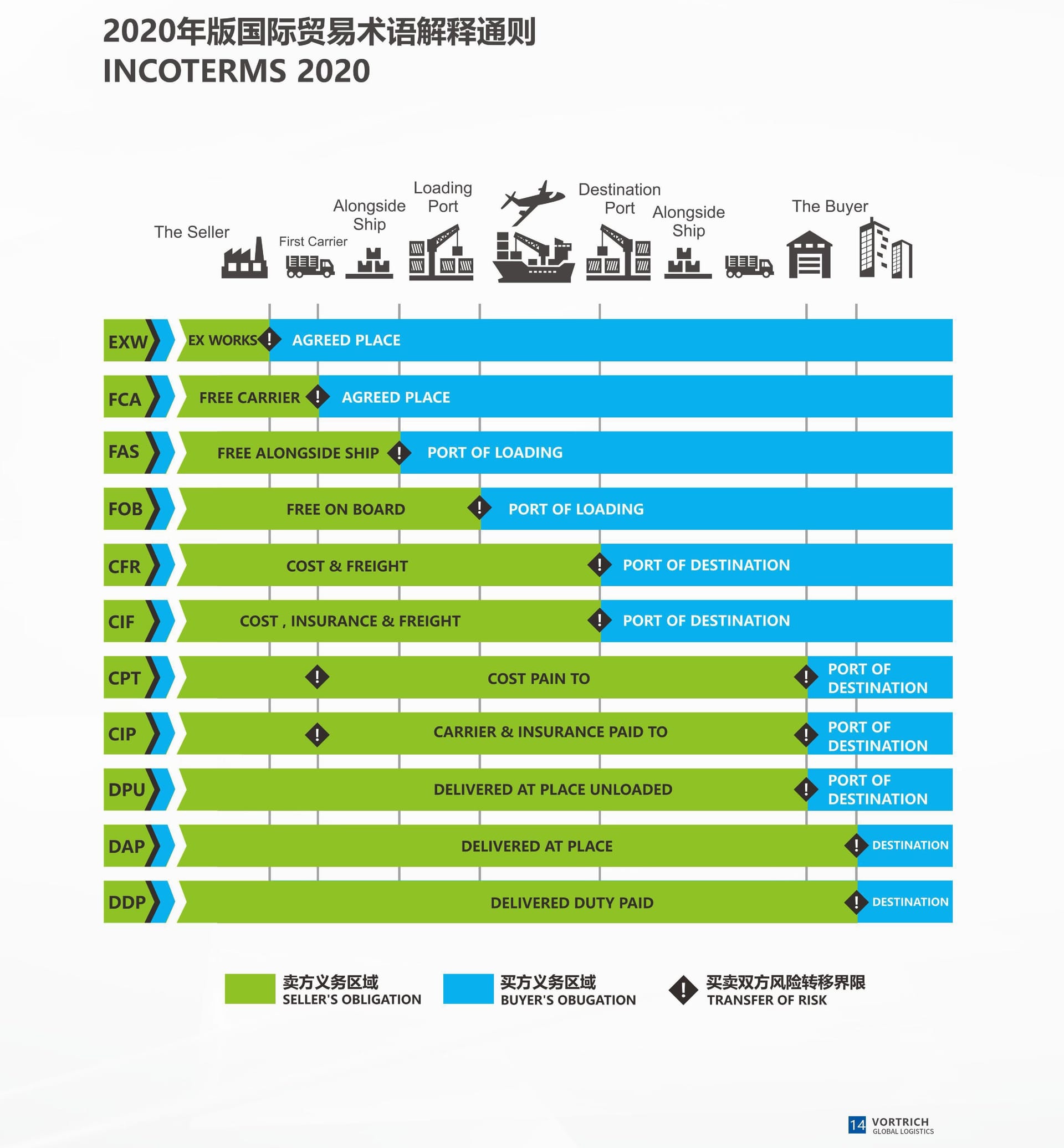
Incoterms (International Commercial Terms) are trade practices established by the International Chamber of Commerce (ICC) that clarify the responsibilities, costs, and risk allocation between buyers and sellers during the delivery process. The latest version, Incoterms 2020, took effect on January 1, 2020, and includes 11 trade terms.
Term Categories
The 11 terms are divided into two categories based on the mode of transport:
Applicable to any mode of transport: EXW, FCA, CPT, CIP, DAP, DPU, DDP Applicable to sea and inland waterway transport: FAS, FOB, CFR, CIF
Detailed Term Explanations
EXW — Ex Works
- Delivery location: Seller’s factory/warehouse
- Risk transfer: At the seller’s factory
- Transport arrangement: Buyer’s responsibility
- Insurance: Each party handles their own
- Best suited for: Buyers with strong logistics capabilities
Note: EXW carries the greatest risk for the buyer — once the seller places the goods at the factory, all risks and costs are borne by the buyer.
FCA — Free Carrier
- Delivery location: Named place
- Risk transfer: When goods are handed over to the carrier
- Export clearance: Seller’s responsibility
FAS — Free Alongside Ship
- Delivery location: Alongside the vessel at the port of shipment
- Risk transfer: When goods are placed alongside the vessel
- Sea transport only
FOB — Free On Board
- Delivery location: On board the vessel at the port of shipment
- Risk transfer: When goods are loaded on board
- Export clearance: Seller’s responsibility
- Best suited for: The most commonly used term for Chinese exports
CFR — Cost and Freight
- Delivery location: Port of destination
- Transport: Seller pays freight to the port of destination
- Risk: Transfers to the buyer when goods are loaded on board
- Insurance: Buyer arranges independently
CIF — Cost, Insurance and Freight
- Delivery location: Port of destination
- Transport: Seller pays freight
- Insurance: Seller covers minimum insurance
- Best suited for: A commonly used term for Chinese imports
CPT — Carriage Paid To
- Delivery location: Place of destination
- Transport: Seller pays freight to the destination
- Risk: Transfers when goods are handed to the first carrier
CIP — Carriage and Insurance Paid To
- Delivery location: Place of destination
- Transport + insurance: Seller’s responsibility
- Note: CIP requires the seller to insure against all risks (ICC A), providing more comprehensive coverage than CIF
DAP — Delivered at Place
- Delivery location: Named place of destination
- Risk transfer: Upon delivery at the destination
- Import clearance: Buyer’s responsibility
- Best suited for: Door-to-door service
DPU — Delivered at Place Unloaded
- Delivery location: Named place of destination
- Risk transfer: After unloading
- Note: The seller is responsible for unloading at the destination! This is a new term in the 2020 version, replacing DAT
DDP — Delivered Duty Paid
- Delivery location: Named place of destination
- Risk transfer: Upon delivery
- Import clearance: Seller’s responsibility (including import duties)
- The term with the greatest responsibility for the seller
Responsibility Allocation Summary
| Term | Transport | Insurance | Export Clearance | Import Clearance | Risk Transfer Point |
|---|---|---|---|---|---|
| EXW | Buyer | Each party | Buyer | Buyer | Factory |
| FCA | Buyer | Each party | Seller | Buyer | Handover to carrier |
| FOB | Buyer | Each party | Seller | Buyer | On board |
| CFR | Seller | Buyer | Seller | Buyer | On board |
| CIF | Seller | Seller | Seller | Buyer | On board |
| DAP | Seller | Each party | Seller | Buyer | Destination |
| DDP | Seller | Each party | Seller | Seller | Destination |
Selection Recommendations
- Chinese exports: FOB or CIF are most commonly used
- Chinese imports: CFR or FOB (to control transport yourself)
- Door-to-door service: DAP or DDP
- Air/rail transport: FCA or CIP
- Avoid EXW whenever possible — export clearance responsibilities are unclear
Vortrich Recommendation: When choosing trade terms, consider the nature of the goods, mode of transport, market practices, and risk management capabilities. If you have any questions, feel free to consult our trade advisory team.